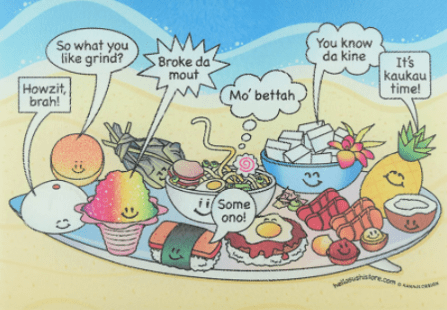
So if you read the last post you know that after Contact, Hawaii was involved with trade and raid with White English speakers. The mixture of cultures produced Hawaiian Pidgin language. Another Accepted Term for Pidgin English is Hawaiian Creole English. (HCE)
Pidgin languages are mixture languages.
Hawaiian Pidgin
Started be spoken in the plantations by adults. Hawaiian Pidgin was used outside the plantation. Children in public schools learned Pidgin from other students and since Hawaiian was outlawed to be spoken in schools, Hawaiian Peventually it became the primary language of most people in Hawaii, replacing the original languages
Chinese Pidgin
Started in Opium Waw 1840. The phrase “long time no see” is a Chinese Pidgin saying from hǎojiǔbújiàn.
Jamaican Pidgin
Nigerian Pidgin
Creole languages are mixture languages.
Haitian Creole
Tongan Creole
Pidgin and Creole languages are both a type of Lingua Franca (pronounced LING-wa FRAN-ka). Lingua Franca is a language that is used as a common language between speakers whose native languages are different.
So what do we do with Pidgin?
Hawaiian Language words that transfer over to Pidgin and What they mean in English
| a hui hou | goodbye |
| aloha | love, sympathy, etc |
| akamai | smart, intelligent |
| akule | a type of fish |
| aliʻi | a chief |
| e kala mai | forgive/excuse me |
| e komo mai | come inside (invitation) |
| hale | house |
| hana | work |
| hana hou | do again, repeat |
| hula | hula |
| hālau | traditional workshop or school of learning |
| hānau | to give birth |
| haole | Caucasian |
| hapa | part, half; mixed race |
| hāpai | pregnant |
| haupia | coconut pudding in blocks |
| hauna | smelly |
| hele | to go (generic) |
| hemo | to remove (really means removed, extracted, or opened)( |
| hikieʻe | a hybrid living room bed/couch |
| holoholo | to go riding around |
| honi | to kiss |
| honu | a turtle |
| hui | a group or organization |
| “hū-ī” | a call to get someone’s attention |
| hukilau | a type of group fishing technique |
| huli | to turn over, as a flipped canoe |
| hulihuli | to rotate something, as on a spit |
| hūpō | stupid, foolish |
| i mua | go forward; in front |
| imu | underground oven |
| kahu | a reverend or priest |
| kahuna | a priest (trad.) or master practitioner |
| kālā | money |
| kalo | taro |
| kamaʻāina | a local or native-born |
| kanaka | a Hawaiian person |
| “kanikapila” | to play music |
| kapakahi | crooked, bent; fig. messed up |
| kapu | forbidden |
| keiki | child |
| Kepanī | of Japanese descent |
| kuleana | responsibility |
| kumu | teacher |
| kupuna | grandparent, ancestor |
| kālua | to bake in an imu |
| kāne | man, male, husband |
| kolohe | rascal, naughty |
| kōkua | help, assistance |
| kūkae | doodoo |
| kukui | a type of tree |
| kūlolo | a type of Hawaiian dessert |
| lānai | veranda, porch |
| lauhala | pandanus leaf |
| laulau | laulau (a type of food) |
| lehua | lehua (a type of blossom) |
| lei | lei garland or necklace |
| lepo | dirty |
| limu | seaweed (usually edible) |
| lōkahi | togetherness, unity |
| luna | the boss, foreman |
| lōlō | stupid, idiotic |
| lua | toilet, bathroom |
| lūʻau | feast often with a show |
| mahalo | thanks |
| mahimahi | a type of fish |
| māhū | homosexual male; crossdresser |
| maikaʻi | good |
| maile | a type of vine |
| maka piapia | sleepy dust (Hwn mng. eyes with dusty pia) |
| makai | seaward (properly ma kai) |
| make | dead |
| mālama | to care for something |
| malihini | a visitor or non-local |
| mana | spiritual power |
| manini | a type of fish; fig., a small thing, “NBD” |
| mauka | upland (properly ma uka) |
| mauna | a mountain |
| menehune | an ancient and mythical race of people |
| moemoe | “go nighty-night” (sleep) for kids |
| momona | fat, obese |
| moʻo | gecko etc. |
| moʻopuna | grandchild, descendant |
| muʻumuʻu | a type of loose dress (mispron. “mūmū”) |
| nēnē | the native Hawaiian goose |
| pakalōlō | marijuana (mispron. as “pakalolo”) |
| pali | a cliff |
| Pākē | of Chinese descent |
| paniolo | cowboy |
| pau | done, finished |
| pau hana | after work is done |
| piko | belly-button |
| pilau | rotten stench, stink; fig. of bad character |
| pilikia | problem |
| pipi | beef, cow, bull |
| pipi kaula | dried beef, similar to beef jerky |
| pōhaku | a rock |
| pohō | useless, wasteful, wasted |
| poi | poi (a smooth taro pudding) |
| poke | poke raw fish dish |
| pōpolo | a person of African descent |
| puaʻa | pig, pork |
| puka | hole (perforated); doorway |
| pūpū | an appetizer (Hawaiian lit., any marine shell) |
| tī | a type of plant (sometimes “kī”) |
| tūtū | grandma (shortened from tupuna) |
| uku pau | to pay off completely |
| wahine | lady, wife, woman, female |
| walaʻau | to chat, idle talk |
| wana | a sea urchin with long painful spines |
| waʻa | canoe |
| wikiwiki | quick, fast |
| ʻahi | a type of fish |
| ʻauʻau | to bathe or shower or “clean up” |
| ʻaumakua | ancestral family god |
| ʻāina | the land |
| ʻehu | a reddish tint in black Hawaiian hair |
| ʻohana | family |
| ʻōkole | human rear end (Hawaiian lit., anus) |
| ʻōkole hao | Hawaiian tī root moonshine |
| ʻono | delicious |
| ʻōpala | rubbish, something which lost its value |
| ʻōpū | stomach, tummy |
| ʻuku | head lice (“ʻukus”) (Hawaiian lit., flea) |
| ʻulu | breadfuit |

